Palma del Río Castle
Portocarrero Palace and Walled Precinct
At the confluence of the Genil and Guadalquivir rivers stands a monument that is a living archive. On the Roman foundations of proconsul Aulus Cornelius Palma and the impregnable Almohad citadel, a Renaissance palace flourished.
This place has seen the birth of cardinals, celebrated weddings of legendary captains, and served as a setting for Hollywood epics. After centuries of history, today it rises restored, guarding a unique botanical museum within its ancient walls.

Secrets and Curiosities
A journey through the secrets hidden in its gardens, its towers, and its memory.

In its gardens grows a unique botanical collection with more than 400 varieties of citrus fruits from around the world, a tribute to the agricultural identity of Palma del Río.

Ridley Scott chose this palace to film “Kingdom of Heaven” (2005). Its Mudejar courtyards recreated the palaces of the Holy Land during the Crusades.

In 1483, facing a Muslim attack, the defenders burned one of the gates to stop the enemy. The “miracle” is commemorated today in the Chapel of Sorrows.

Legend speaks of a spectral female figure appearing on the loggia and walls on full moon nights, guardian of the traumatic memory of the lineage.

On February 14, 1489, the palace hosted the wedding of Gonzalo Fernández de Córdoba, the “Great Captain,” uniting his destiny with the House of Portocarrero.

It is not only medieval; its foundations are Roman. Its foundation is attributed to Consul Aulus Cornelius Palma (105 AD) as a praetorium to control river trade.
Architecture of the Fortress

A perfect synthesis where Almohad military engineering embraces the elegance of the Italian Renaissance and the Mudejar tradition.
Surrounding the manorial complex extends an imposing 12th-century defensive wall built of rammed earth. This Islamic fortification, with its quadrangular towers, acts as a protective “case” that isolated the palace from the outside and allowed its preservation.
On the main façade, a magnificent 16th-century corner balcony stands out. Of Plateresque style and flanked by columns, it displays the heraldic shields of the Portocarrero family and served as a stage of power facing the public square.
Breaking with the closed military tradition, the palace incorporates an Italian-style loggia or lookout. Its open arches towards the Genil River allowed enjoying the breeze and views, introducing the Renaissance concept of aesthetic pleasure into architecture.
Known locally by this name, it is the old main albarrana tower of the Almohad citadel. A massive defensive structure that protected the most exposed flank, recalling the purely military origin of the precinct before its palatial transformation.
The soul of the palace resides in its interior courtyards, direct heirs of the Andalusi tradition. The water from the fountains, the shade of the orange trees, and the porticoed galleries create a sensory microclimate that fuses architecture with nature.
A singular octagonal (ochavada) tower that is part of the Almohad defensive belt. Its complex geometry distinguishes it from the usual square towers, and over time it was adapted to house the Chapel of Sorrows.
Chronological History
Aulus Cornelius Palma
The Roman governor founds the first fortified settlement (praetorium) to control the river trade of oil and grain.
The Almohad Alcázar
The Almohad Empire builds the formidable rammed earth walled precinct and defensive towers in the face of Christian advance.
Lordship of Bocanegra
Alfonso XI grants the lordship to the Genoese admiral Egidio Bocanegra, initiating the Christian stage of the fortress.
Wedding of the Great Captain
The palace hosts the marriage of Gonzalo Fernández de Córdoba, consolidating the alliance with the House of Portocarrero.
The Renaissance Palace
Luis Fernández Portocarrero transforms the military fortress into a palatial residence, opening loggias and balconies.
Restoration and Cinema
After a meticulous restoration, Ridley Scott films “Kingdom of Heaven,” projecting the monument to the world.
Image Gallery


Plan Your Visit
“Mudejar gardens and movie sets”
Portocarrero Palace
Guided Tours:
Saturdays, Sundays, and Holidays: 12:00h
Weekdays: Arranged groups
Reservations: 670 88 52 38 / info@palacioportocarrero.comTourist Office
Walled Precinct:
📞 957 64 43 70
turismo@palmadelrio.es
Calle Santa Clara, s/n (at the Santa Clara Creative and Cultural Space)
Don’t Miss
The palace, its gardens, and the sets of “Kingdom of Heaven.”
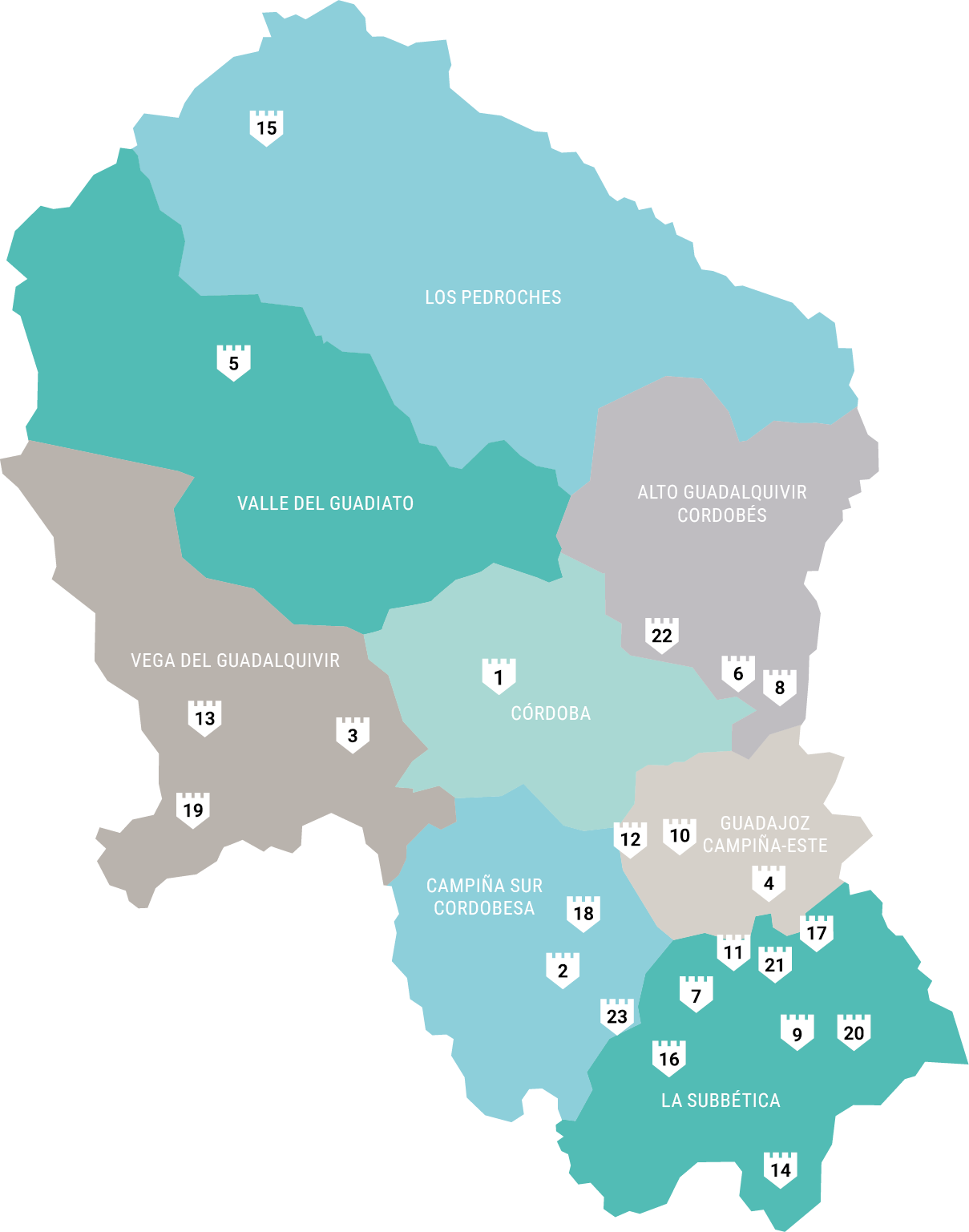
More Castles in Córdoba Province
Discover the complete defensive network. Click on the map numbers or use the search bar below.