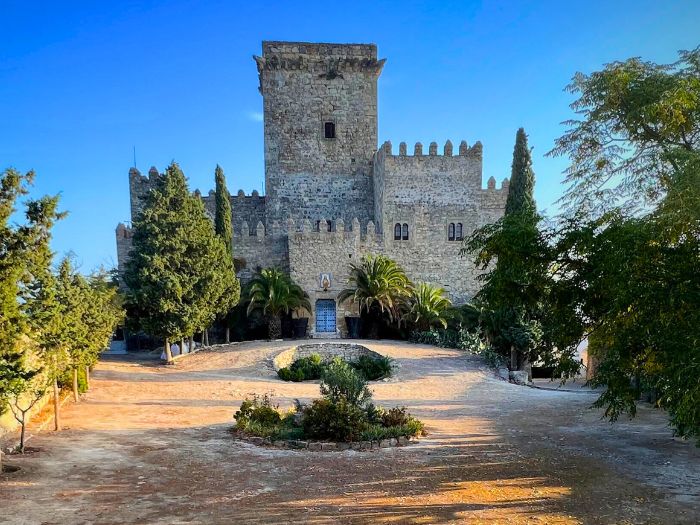
Ducal Castle of Espejo
Fortress over Ucubi
This bastion is much more than a medieval fortress. Rising above the Cordovan Countryside, it sits on the ruins of ancient Ucubi, a city loyal to Julius Caesar in the war against Pompey.
Rebuilt by Pay Arias de Castro in the 14th century, the castle has witnessed millennia of history. From its battlements the Nasrid frontier was watched, and in the 20th century, its slopes were the setting for Robert Capa’s most iconic photograph: “The Falling Soldier.”

Secrets and Curiosities
A place where Roman archaeology, medieval epic, and 20th-century memory coexist.

In 1936, Robert Capa captured his famous image “The Falling Soldier” here. Recent investigations confirmed that the background landscape corresponds to the Haza del Reloj, next to the castle.
Beneath the foundations of the castle lies the colony Claritas Iulia Ucubi. The city supported Caesar in the Battle of Munda (45 BC) and was burned by the Pompeians in retaliation.

Under the parade ground hides an immense Roman and medieval cistern. Its capacity guaranteed the survival of the garrison during prolonged sieges on the border.

It is said that on the night of San Juan a young Moorish woman (“The Enchanted One”) appears looking for her lost love, eternally trapped between two eras and cultures.

Oral tradition insists on the existence of secret underground galleries connecting the castle with the Roman site of La Albuhera, serving as an escape route.

The name “Espejo” does not come from the object (mirror), but from the Latin Specula (watchtower). Its location at the highest point made it the “all-seeing eye” over the countryside.
Gothic Fortress

Designed by Pay Arias de Castro at the end of the 13th century, it is a perfect example of a seigniorial castle adapted for defense and visual control.
It is the main and most robust structure of the complex. Known as “the donjon,” this tower visually dominates the entire Cordovan countryside. Its massive construction served both as a last defensive refuge and a symbol of feudal power of the Pay Arias family.
This advanced bastion, located on the southern flank, acted as a defensive prow. Its forward position allowed crossfire on the main walls and served as a platform for optical signals, visually connecting with other watchtowers on the frontier.
The castle presents an almost perfect quadrangular plan, defended by four towers at the corners. Its very thick walls and crenellated wall-walk create a compact and difficult-to-storm perimeter, designed to withstand both sieges and rapid attacks.
In the center of the fortress opens the Parade Ground, which hides a vital cistern and the extraction well in its subsoil. Over the centuries, its originally open galleries were closed and glazed to adapt the space for residential use by the House of Osuna.
Remaining inhabited and in private hands, the castle retains its “soul.” It houses a valuable historical archive, a collection of ancient weapons, and period furniture that recreate the daily life of the Andalusian nobility through the centuries.
Next to the medieval walls is this impressive hydraulic structure from the 1st century BC. Built in opus caementicium (Roman concrete), this reservoir supplied the ancient colony of Ucubi, demonstrating the historical continuity of the place.
Timeline
Battle of Munda
The oppidum of Ucubi supports Julius Caesar. After being burned by the Pompeians, it is reborn as Colonia Claritas Iulia Ucubi.
The Lordship
Ferdinand IV grants the lordship to Pay Arias de Castro, who begins the construction of the current Gothic castle to defend the frontier.
Noble Consolidation
Through marriage alliances, the castle passes to the House of Córdoba and subsequently to the House of Osuna, transforming into a palace.
Civil War
The castle and its surroundings are the scene of combat. Robert Capa takes the photograph “The Falling Soldier” here.
Legal Protection
The castle is declared a Site of Cultural Interest (BIC), guaranteeing its preservation for the future.
House of Osuna
Property of the XVI Duchess of Osuna, the castle is open to the public with cultural visits and theatrical routes.
Image Gallery


Plan Your Visit
“The impregnable fortress of the House of Osuna”
Visits
Private Property
Guided tours for Groups / Individuals / Schools
Theatrical Tours // Themed Tours
Advance booking essential
Managed by Castillo Ducal de EspejoContact and Reservations
📞 672 21 38 83 // 696 85 34 58
🌐 www.castilloducaldeespejo.com
📧 info@castilloducaldeespejo.com
Office Hours: Mon-Fri from 9:00 to 14:00
Surroundings
Iconic location of the photo “The Falling Soldier” (Robert Capa)
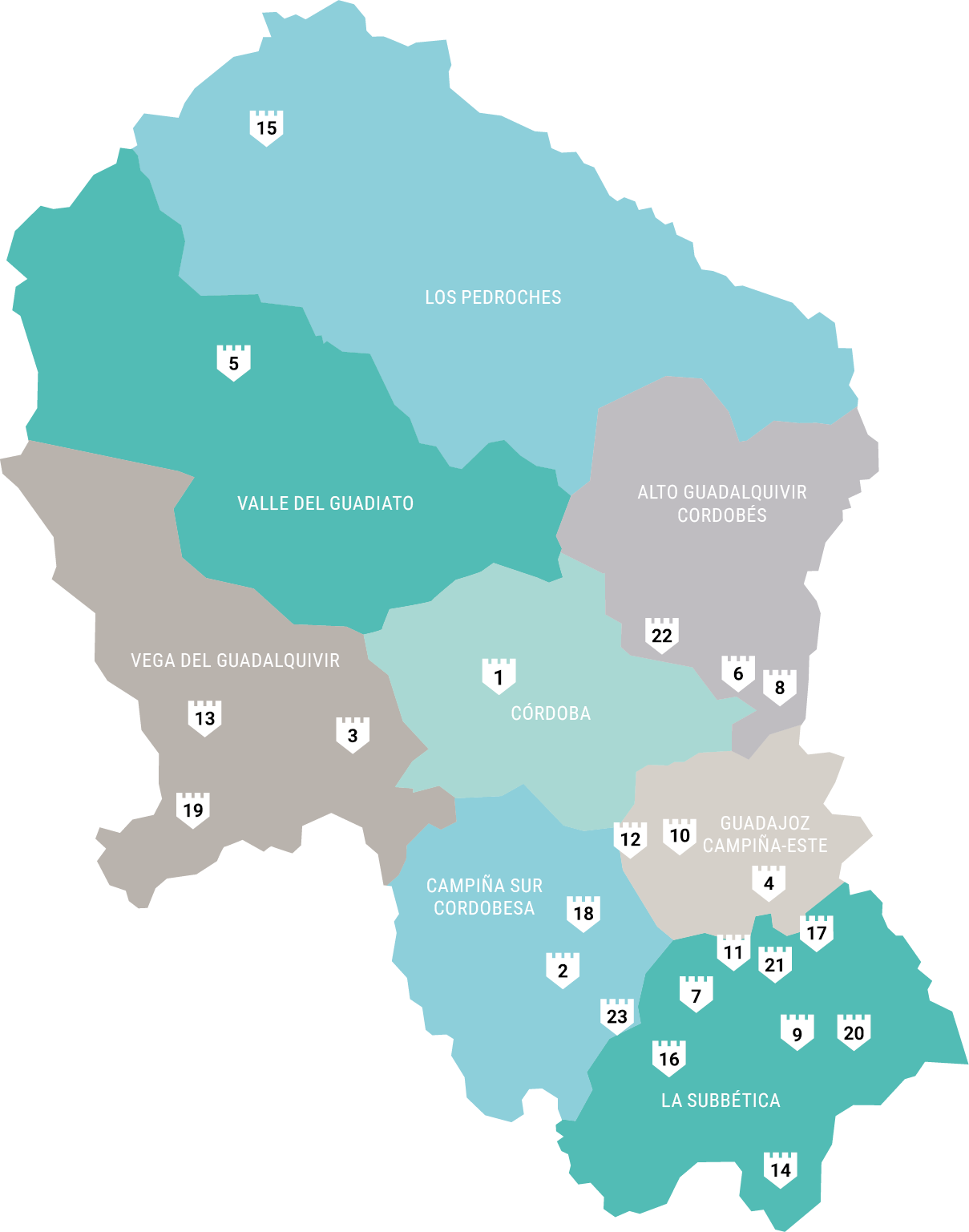
More Castles in Córdoba Province
Discover the complete defensive network. Click on the map numbers or use the search bar below.