Castro del Río Castle
Palimpsest in the Countryside
This castle is the keystone of the Town. Sitting on a meander of the Guadajoz river, it rises above Roman foundations and the old Almohad medina. It was here where the history of literature and war crossed paths.
Its walls hold the memory of Miguel de Cervantes, who suffered imprisonment in the town while conceiving Don Quixote. In the 20th century, its towers served as a radio post in the Civil War, leaving graffiti that are today living history alongside medieval architecture.

Secrets and Curiosities
From the prison of the most universal writer to the laments of the Cantamora, every stone tells a story.

In 1592, Miguel de Cervantes was imprisoned in the Royal Jail (today Aula Cervantina) for irregularities as a tax collector. It is said that here he began to devise Don Quixote.

During the Civil War (1936), the rebel side installed a transmitter in the Cylindrical Tower. Soldiers left graffiti and technical diagrams on the walls that are still preserved.

It is told that on the night of Saint Blaise, a young Moorish woman appears combing her hair and singing laments for her lost love, foretelling misfortunes to whoever sees her.

The northeast tower is circular on the outside to deflect projectiles, but octagonal on the inside, housing a monumental 80 m³ cistern that guaranteed survival.

The name “Castro” comes from the Latin Castra (camp). The castle sits on Roman foundations that controlled the oil trade along the Salsum river (Guadajoz).

A recent restoration has recovered the Keep with chestnut wood and forging, opening a spectacular viewpoint over the La Villa neighborhood and the river.
Anatomy of the Fortress

A seigniorial castle inserted into an Almohad precinct, adapted for defense and administrative life over the centuries.
Recently restored and open to the public, this prismatic structure stands out for its rammed earth construction (“tapial”), a legacy of the Almohad technique. It served as the last defensive redoubt and symbol of seigniorial power over the town, offering incomparable panoramic views today.
The castle is not an isolated building but an integral part of the wall that embraces the Barrio de la Villa. This fortified enclosure of Almohad origin (12th century) protected the medina and was reused and reinforced after the Christian conquest, creating an impregnable defensive complex.
Located in the northeast corner, this tower presents a curious duality: circular plan on the outside to repel projectiles and octagonal plan on the inside. Its walls preserve graffiti and technical diagrams of its use as a radio station during the Spanish Civil War.
Hidden under the Cylindrical Tower, there is a monumental water tank with a capacity of 80,000 liters. Built with hydraulic mastery, it guaranteed the supply to the garrison and the town’s population in case of prolonged siege or drought.
Access to the noble precinct was through an ashlar portal with a semicircular arch, defensively flanked. This entrance marked the boundary between the common town and the space reserved for the warden or lord of the castle.
In the heart of the fortress opens a rectangular space of about 500 square meters. Once a place for troop formation and logistical distribution, today it is a space recovered for culture and visitor enjoyment.
Timeline
Castra Soricaria
Roman military settlement for the control of the Guadajoz river (Salsum) and the oil trade.
Almohad Wall
Construction of the fortified rammed earth precinct surrounding the medina in the face of Christian advance.
Christian Conquest
Ferdinand III takes the town. Construction of the seigniorial castle attached to the Islamic wall begins.
Cervantes
Miguel de Cervantes lives in the town as a royal commissioner and suffers imprisonment in the Royal Jail (City Hall).
Civil War
The castle is used as a radio post. Soldiers leave historical inscriptions on the walls.
Restoration
Comprehensive recovery project of the Keep and opening to cultural tourism.
Image Gallery


Plan Your Visit
“Discover the fortress of Cervantes and olive wood craftsmanship”
Visits
Access to Parade Ground and Viewpoint
Check hours at Tourist Office
Guided tours for groups
Managed by the City CouncilInformation and Contact
Tourist Office: 957 37 23 77
turismo@castrodelrio.es
Plaza de San Rafael, 1 (City Hall)
Don’t Miss
The Villa Neighborhood (Historic Complex) and olive wood craft workshops.
More Castles in Córdoba Province
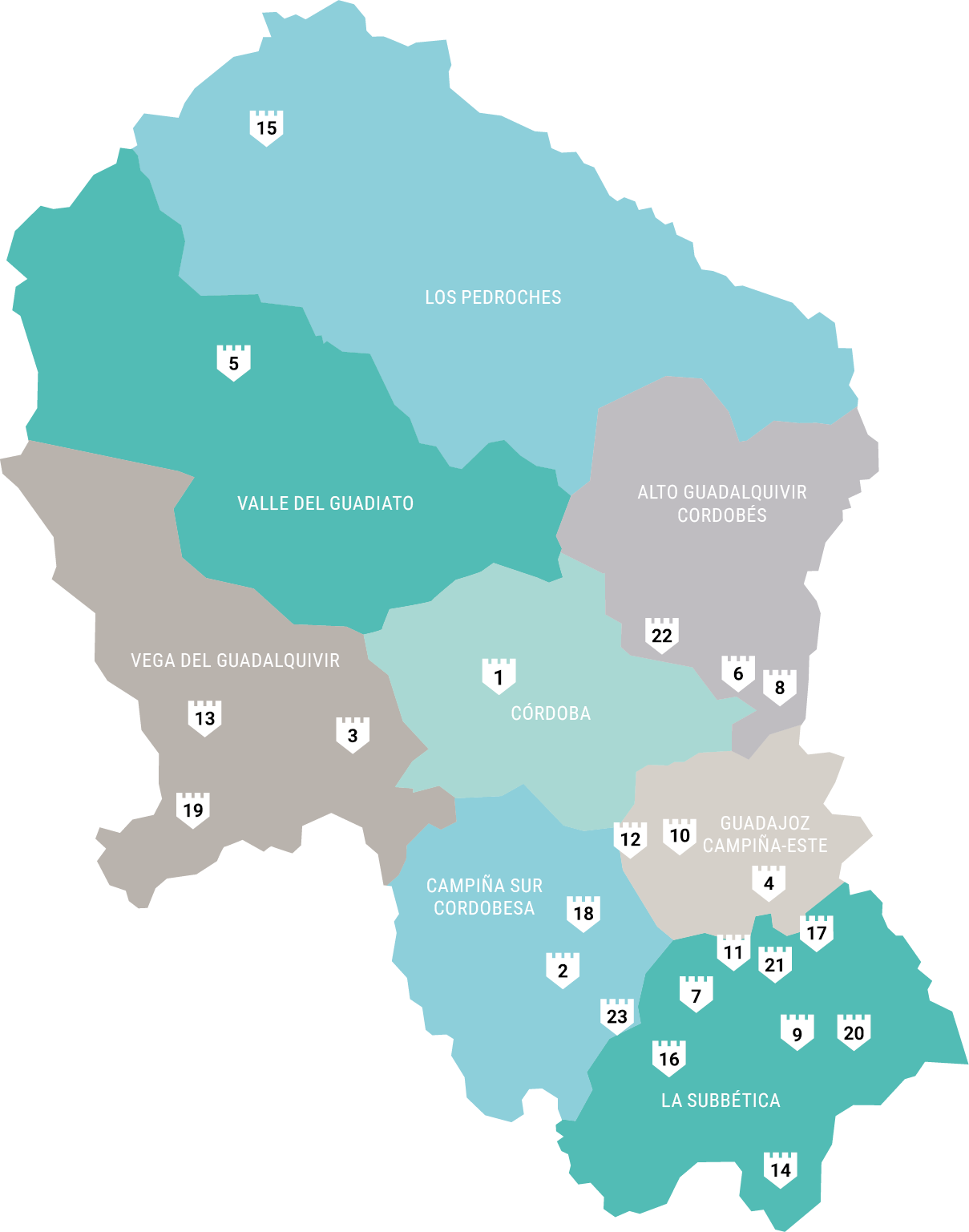
Discover the complete defensive network. Click on the map numbers or use the search bar below.