Castle of Doña Mencía
Erected by the House of Córdoba
The castle of Doña Mencía is a stratified historical document. It rises controlling the ancient Road of Metedores, integrating into a landscape where history and olive trees merge.
Built in the 15th century by the House of Córdoba, it was a border bastion, a ducal oil mill, and a literary setting immortalized by Juan Valera. Its walls guard legends of the Great Captain (Gran Capitán) and testimonies of occupation spanning millennia.

Secrets and Curiosities

The literature of Juan Valera places the prison and romance of the young Great Captain here. Although there were real family conflicts, the romance is an evocative literary invention.

Although the name is associated with Mencía López de Haro (13th century), the current town is a 15th-century foundation. The name is a later genealogical tribute by the lords of the House of Córdoba.

Under the castle area, human remains, seeds, and storage items dating back to the Neolithic have appeared, revealing a human occupation that precedes the medieval stone by millennia.

In the 17th century, the fortress lost its military use and became an industrial oil mill. The Duke exercised his power by forcing his vassals to mill their harvest there.

Writer Juan Valera turned this castle into the setting for his works, calling the town “Villabermeja”. His stories fixed the legends in the collective memory.

Plasterworks with Nasrid Arab decoration have been found. The 15th-century Christian lords decorated their rooms imitating the aesthetic refinement of the Alhambra.
Architecture of the Castle

Located on the eastern side, it served as the last bastion and residence. Its interior houses a vaulted room with an octagonal dome on pendentives, reflecting the refinement of the House of Córdoba.
The corners are defended by circular towers. This advanced typology offered greater resistance to artillery and eliminated blind spots in defensive fire.
Located on the sides next to the parade ground, this 17th-century oil mill bears witness to the economic transformation of the castle under ducal rule.
Built a few years after the castle and connected to it by an arch. Together with Llana street, it represents the heart and foundational origin of Doña Mencía.
Central space that organized the fortress. Excavations reveal overlapping structures from different eras, from prehistoric huts to palatial rooms.
Located on the second floor of the House of Culture, it guards pieces recovered in the castle and the El Laderón site, such as Neolithic stone idols.
Chronological History
First Settlements
Storage remains and seeds found under the castle plot confirm a millennial human occupation.
Foundation of the Castle
Diego Fernández de Córdoba orders its construction to consolidate his lordship on the border with Granada.
Industrial Transformation
The enclosure becomes a ducal oil mill, a symbol of economic power over the vassal population.
Literary Inspiration
Juan Valera immortalizes the fortress in his works, fixing the legends of the Great Captain in the collective imagination.
Monumental Complex
The complex of the Castle, the wall, and the portal of the Old Church is a must-see tour for visitors.
Image Gallery


Plan Your Visit
Opening Hours and Tours
Tuesday to Saturday: 10:00 – 14:00
Free guided tours: Saturdays 10:30 and 12:00
Information and Reservations
Free Admission
Tourist Office: 661 86 84 41
oficinadeturismo@donamencia.es
More Castles in Córdoba Province
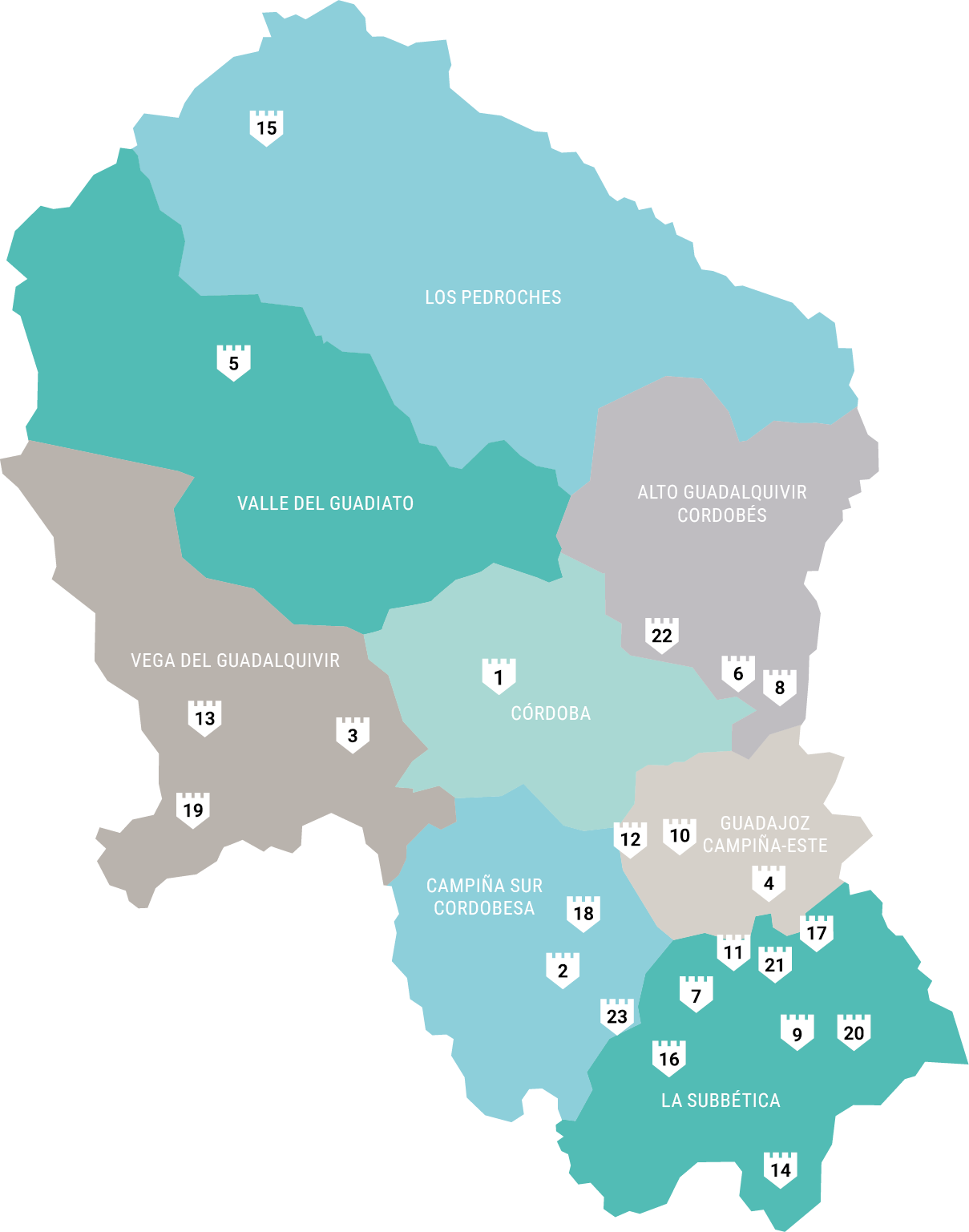
Discover the complete defensive network. Click on the map numbers or use the search engine below.