Poley Castle (Aguilar)
The Castle of Aguilar de la Frontera
At the witness hill of the South Countryside stands a fortress that is an archive of stone. Since prehistory, this place has been a key pass and scene of decisive battles.
Known as Ipagrum by the Romans and Hisn Poley by the Andalusis, it was here that the rebel Omar Ben Hafsun challenged the Emirate of Córdoba in 891. After the Christian conquest, it became the impregnable residence of the Lords of Aguilar, adapting in the 15th century to the era of gunpowder with revolutionary engineering, only to end up being a victim of plundering in the 19th century and reborn thanks to modern archaeology.

Secrets and Curiosities
Among its ruins and restored foundations resonate the voices of Muladi rebels, cruel kings, and sacred legends.

Omar Ben Hafsun made Poley his headquarters to threaten Córdoba. In 891, Emir Abd Allah crushed the rebellion here in a bloody battle that reaffirmed Umayyad power over al-Andalus.

Alonso de Aguilar (15th century) built the Falsabraga: a low, broken wall with embrasures for cannons. Designed for “grazing fire,” it swept the enemy field before they reached the high walls.

Legend tells that Christians hid an image of the Virgin in a cave (soterraño) before the Islamic invasion. Centuries later, it appeared miraculously, giving rise to the patron saint of Aguilar.

A unique albarrana tower, joined to the precinct by an aerial arch. It owes its name to chains sculpted in the stone, a heraldic symbol of strength and union of the Fernández de Córdoba.

In 1353, King Peter I “The Cruel” besieged the castle to punish the rebellion of Fernández Coronel. After taking it, he ordered all the shields of the traitor to be chiseled off and attempted to change the name of the town to “Monterreal.”

The castle’s greatest enemy was not war, but the administration of the 19th century. Its use as a municipal quarry was authorized, dismantling its towers to pave the streets of Aguilar.
Architecture of Poley Castle

From the Iberian oppidum to the artillery fortress, the Castle Hill has evolved to be a perfect war machine adapted to the orography.
Strategically located on the north cliff, this seigniorial structure was the residential and defensive heart. Although partially preserved today, its remains evidence the grandeur of a tower that combined military strength with the comfort of a Gothic ribbed vault inside.
An impressive circular albarrana tower projecting from the walled enclosure, connected by a bridge or arch. Its design allowed flanking enemies attacking the walls and is a visual testament to the lineage of the Aguilars.
Also known as “Tower of Memory” in some phases, it features a pentagonal prow plan. This advanced geometry is not aesthetic but functional: by presenting an acute angle towards the attacker, artillery projectiles glanced off instead of impacting directly.
It is the most distinctive element of Poley. A low forewall, built in front of the main wall, designed specifically for artillery. Its embrasures allowed firing cannons at ground level against enemy infantry, a technological revolution of the 15th century.
The visit is not only medieval. Archaeological works have brought to light the foundations of the Roman city of Ipagrum. Walls of opus quadratum and cisterns remind us that this hill was a flourishing municipium long before the arrival of Islam.
The Landscape and History Interpretation Center (CIPHAF) integrates the ruins with modernity. Through walkways and viewpoints, the visitor can understand the stratigraphy of the place and enjoy the views over the “Route of the raisin and wine” of Montilla-Moriles.
Historical Timeline
Prehistoric Origins
First settlements with silos excavated in the rock and later fortified Iberian oppidum.
Municipium Ipagrum
Splendor of the Roman city. The hill functions as an acropolis and noble zone with public buildings.
Battle of Poley
The rebel Omar Ben Hafsun is defeated by Emir Abd Allah at the foot of the castle, marking the end of the great Muladi revolt.
Lordship of Aguilar
After the conquest by Ferdinand III (1240), Alfonso X grants the town to Gonzalo Yáñez, creating the Lordship.
The Royal Siege
Peter I the Cruel takes the castle to quell the rebellion of Alfonso Fernández Coronel and orders his heraldic memory erased.
Artillery Reform
Alonso de Aguilar adapts the fortress to pyroballistics by building the falsabraga and advanced towers.
The Quarry
The local administration authorizes the dismantling of the castle to use its stones in civil works of the town.
Recovery
Inauguration of the CIPHAF and enhancement of archaeological remains for the public.
Image Gallery


Plan Your Visit
“Discover the legacy of Ipagrum and Poley”
Tourist Office
Aguilar City Council
Plaza de San José, 1
14900 Aguilar de la Frontera (Córdoba)
Contact and Hours
📞 957 66 00 00
📧 turismo@aguilardelafrontera.es
Castle Hours: Free access to the outer precinct.
Interpretation Center: Consult by appointment.
Location of the Precinct
Access via Cuesta de Jesús, s/n (Cerro del Castillo)
More Castles in Córdoba Province
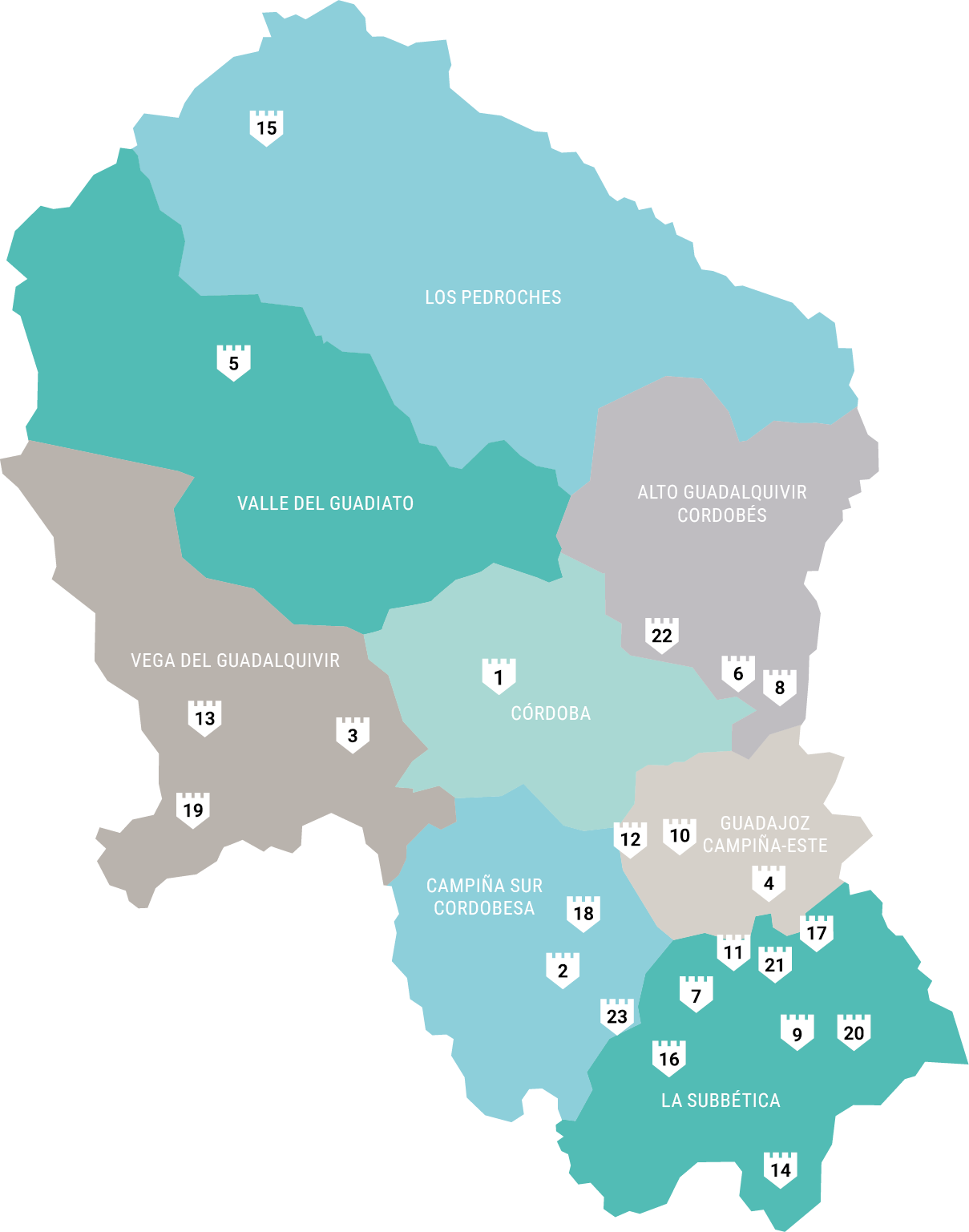
Discover the complete defensive network. Click on the map numbers or use the search engine below.