Baena Castle
From Bayyana to Ducal Palace
This castle is a stone palimpsest rising above the heart of the Countryside. Known as Bayyana in the 9th century, it was the capital of a cora (province) and headquarters of the emiral cavalry to control the Muladi rebellions.
After the Christian conquest, its walls housed Boabdil the Small and the Great Captain himself, a prisoner of his own family. In the 21st century, it has been reborn after a bold restoration that combines the original ruin with modern reintegration, returning its historical profile to Baena.

Secrets and Curiosities
Among its restored towers and rammed earth walls hide tales of family betrayals, tragic legends, and archaeological finds.

After the Battle of Lucena in 1483, the last Sultan of Granada, Boabdil the Small, was held in the Tower of the Archers before being handed over to the Catholic Monarchs, turning the castle into a state prison.

Around 1473, a young Gonzalo Fernández de Córdoba (future Great Captain) spent more than three years imprisoned in this castle, captured by his own cousin, the Count of Cabra, due to fierce family disputes.

The 21st-century intervention rejected the “historical fake.” Sandstone blocks with differentiated texture and iroko wood walkways that “float” inside the towers were used, making the construction history legible.

Its name is not accidental. Archaeologically, it is a “double tower”: a Christian structure that encased and hid an earlier Islamic tower, preserving the original Almohad fabric inside.
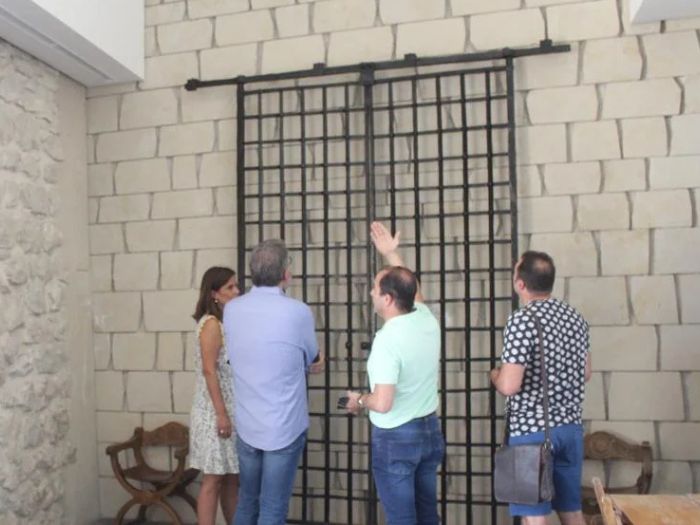
In 2019, after being missing for decades, the fortress recovered its original 15th-century gate. Six hundred kilos of slow-forged iron whose imperfections remind us that heritage always retains enough gravity to return home.

Although found at the Iponuba site, a replica of this Iberian sculpture from the 4th century BC guards the entrance, symbolizing the defensive continuity of the hill since prehistoric antiquity.
Architecture of Baena Castle

From military citadel to Renaissance ducal palace, its architecture is a testament to the defensive and residential evolution.
This pentagonal structure is the old Keep. Its five corners are not whimsical: they are designed to deflect enemy projectiles. It was the main residential core and the prison of illustrious figures like Boabdil.
More than a tower, it is an archaeological puzzle. It is an “encased” tower: Christian builders lined an earlier 12th-century Islamic tower with new walls, preserving it intact inside as an architectural fossil.
Located next to the Gate of the Field, this tower was part of the flanking system that protected the southern access to the precinct. Its position was vital for the defense of the Almedina, the noble and administrative area of the fortress.
The 21st-century restoration introduced a modern and respectful element: walkways of iroko wood and stainless steel. These structures float inside the emptied towers, allowing tourist traffic without damaging the original historic walls.
In the 16th century, the military function gave way to the residential one. The Dukes of Baena opened large windows and created interior courtyards, transforming the grim fortress into a Renaissance palace adapted to the new standards of noble comfort.
The reintegration of the lost volumes was carried out with blocks of sandstone carved with a special texture on the faces. This makes the light “vibrate” differently on the new parts, allowing the modern intervention to be clearly distinguished from the original ruin.
Historical Timeline
Rise of Bayyana
The rebel Umar ibn Hafsun takes the castle. Emir Abd Allah recovers it and establishes a garrison, elevating the site to the capital of a cora.
Almohad Phase
Facing Christian pressure, defenses are reinforced. The core of the Tower of the Secret dates from this period of North African struggles.
Christian Conquest
Ferdinand III the Saint incorporates Baena into Castile through capitulation. The town initially remains as royal land.
The Lordship
After decades of neighborhood resistance, the dominion of the Fernández de Córdoba is consolidated, transforming the castle into a seigniorial seat.
Illustrious Prisoners
The dungeons house the future Great Captain (due to family disputes) and later King Boabdil of Granada after his capture.
Comprehensive Restoration
The ambitious architectural recovery project is executed, returning volume to the castle and opening it to the public.
Image Gallery


Plan Your Visit
“Explore the Almedina and the 21st-century restoration”
Tourist Office
Baena City Council
Calle Virrey del Pino, 5
14850 Baena (Córdoba)
Contact and Hours
📞 957 671 757
📧 turismo@ayto-baena.es
Visiting hours: Consult season.
Access to the walled precinct.
Location
Plaza Palacio, s/n (Upper part of the city)
More Castles in Córdoba Province
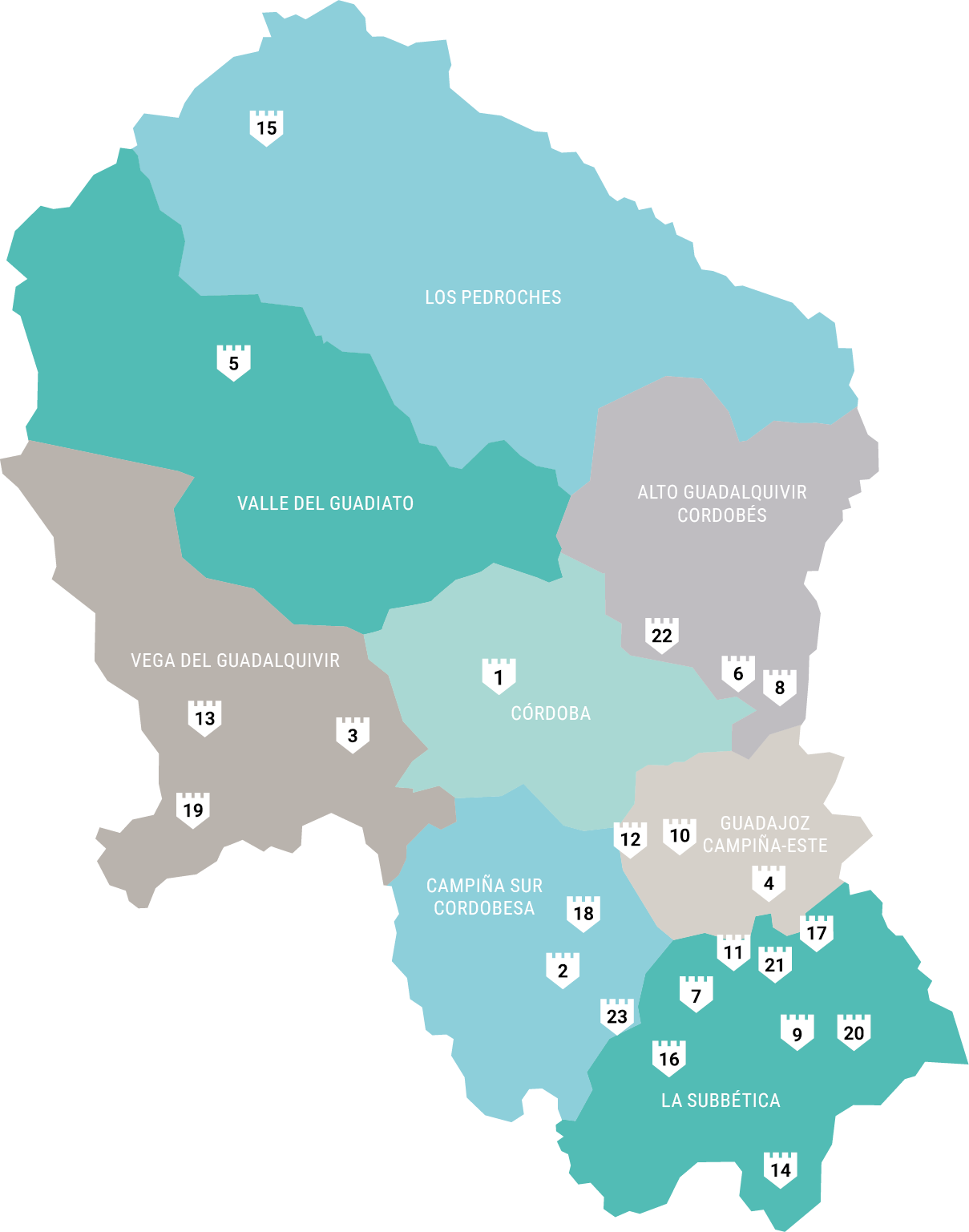
Discover the complete defensive network. Click on the map numbers or use the search bar below.