Belmez Castle
Guardian of the Alto Guadiato
The guardian of the Alto Guadiato stands on a limestone spur. This castle is a suit made to measure for the rock, designed to control natural passes, borders, and mines.
From its medieval origins to the French occupation in 1810, its walls have withstood wars and the advance of an industrial quarry. Today, thanks to the science of the University of Córdoba, it has become a virtual archaeology laboratory pioneering in Europe.
Secrets and Curiosities
Between popular legend and documented history, the castle reveals its deepest secrets.

Between 1810 and 1812, Napoleonic troops took the castle, repaired its defenses, and used it as a base. Upon withdrawing, they attempted to blow it up to render it useless.

In the parade ground, a peculiarly shaped cistern is known as “the horse’s footprint.” Legend says it always has water, defying the dryness of the hill.

The University of Córdoba has turned the castle into a pioneering case study, using LiDAR technology and photogrammetry to create a scientific “virtual lookout.”

In the 19th century, a quarry at the foot of the hill threatened to devour the fortress. The struggle between heritage and the mining industry marked its recent history.

After the Christian conquest (1235), the castle passed to the Order of Calatrava, integrating into the network of fortresses defending the frontier with Granada.

Access from the Steep Street is a psychological trap: a zigzagging and exhausting path designed to tire the attacker before reaching the gate.
Architecture of Belmez Castle

An elongated and organic fortress, millimetrically adapted to the limestone spur to dominate the valley.
It is the dominant vertex of the fortress. A main and massive structure that stands defiantly over the town. Its interior, austere and robust, has two floors covered by brick vaults, designed to resist and command the valley.
The castle does not follow a geometric plan, but obeys geology. Its elongated plan merges with the crest of the limestone rock, making the precipice itself act as an insurmountable natural wall.
To break the monotony of the wall and avoid blind spots, several semicircular towers project from the canvas, generally cited as six according to most sources. These structures allowed crossfire, protecting the flanks of the main wall against any assault.
Entry is not given away. The original access forces a sharp turn or bend under the surveillance of the towers, a traditional poliorcetic technique that prevented the enemy from using battering rams with force or entering in a rush.
This vital reservoir was excavated in the bare rock of the parade ground. Fundamental for survival on a dry hill, it guaranteed water supply to the garrison during prolonged sieges.
There are no unnecessary luxuries here. Local masonry joined with lime predominates, with ashlar or brick reinforcements only where the structure demanded it. It is an architecture of pure military functionality and resistance.
Chronological History
Origins
Evidence of fortification for territorial control of the valley and natural passes towards the plateau.
Christian Conquest
Ferdinand III takes the stronghold. Documentary records begin, along with its integration into the Order of Calatrava.
Late Medieval Reform
Great “tune-up” of the defenses (walls and Keep) in the face of final frontier pressure.
Peninsular War
French occupation. Napoleonic troops repair the castle and then attempt to blow it up upon retreating.
Mining Threat
An industrial quarry undermines the base of the hill, endangering the stability of the historical fortress.
Restoration and Science
Interventions by Félix Hernández and recent studies by UCO turn the castle into a model of virtual archaeology.
Image Gallery


Plan Your Visit
“Climb the zigzag stairs and dominate the Guadiato”
Opening Hours
Winter: 10:00 – 12:30 | 16:00 – 19:00
Summer: 10:30 – 12:30 | 19:00 – 22:00
Free AdmissionInformation and Contact
Tourist Office: 673 10 18 17
turismobelmez@gmail.com
C/ Córdoba, 3 (Historical Museum)
Don’t Miss
Panoramic views from the Keep and the nearby Sierra Boyera Reservoir.
More Castles in Córdoba Province
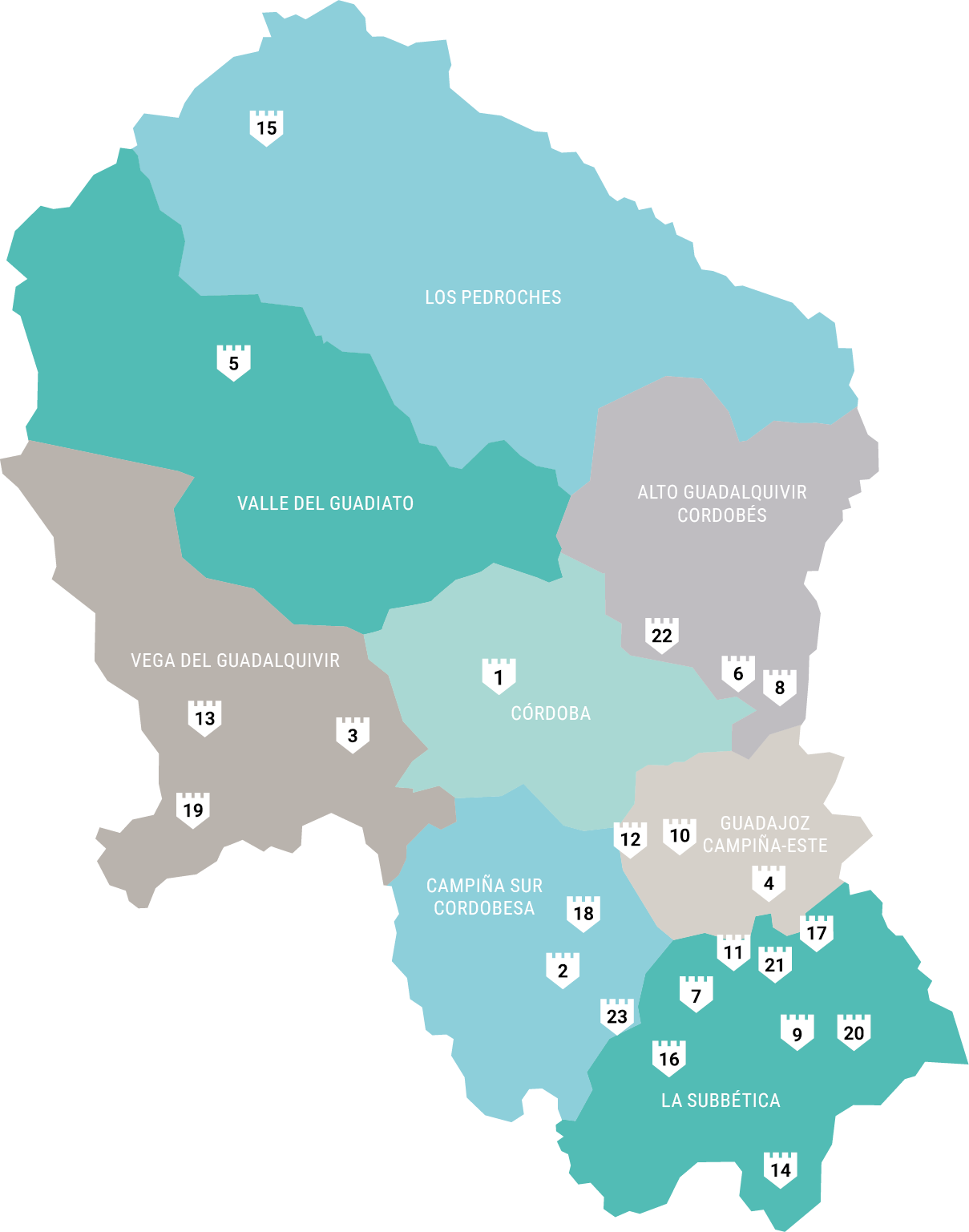
Discover the complete defensive network. Click on the map numbers or use the search bar below.