Castle of the Counts of Cabra
Upon Roman foundations and Andalusian alcazaba
This monument is the most complex historical document in Cabra. Built on Roman foundations and the ancient Andalusian alcazaba, it has uninterruptedly watched over the Subbética for more than a millennium.
It was here that the last king of Granada, Boabdil the Young, suffered his first imprisonment after the Battle of Lucena. Its walls saw a young Miguel de Cervantes grow up under the tutelage of his uncle, the mayor, and centuries later, it was transformed into the Neo-Mudéjar workshop of a “Romantic Count.” Today, it remains alive as a school, uniting its noble past with an educational future.

Secrets and Curiosities
From royal prisoners to hidden crypts, the castle guards secrets that have forged the history of Spain.

In 1483, after being captured at the Battle of Lucena by the Count of Cabra, the Nasrid sultan Boabdil was held in this fortress. His sword, clothes, and slippers were kept here as war trophies.

Miguel de Cervantes lived in Cabra between 1558 and 1563. His uncle Andrés was the town’s mayor and worked for the Dukes of Sessa. The writer grew up in the shadow of these walls and would later mention the “Abyss of Cabra” in Don Quixote.

In the 19th century, Luis Osorio de Moscoso turned the castle into his painting workshop. He transformed the interior with an idealized Neo-Mudéjar style, filling it with frescoes and Orientalist fantasy.

Recently, construction work revealed the burial crypt of the Counts beneath the annexed former Capuchin convent. An intact archaeological find that recovers the memory of the lords of the town.

Generations of students from the Pious Schools (Escolapias) speak of “El Pisón,” a spectral presence whose heavy footsteps echo at night through the old corridors of the castle-school.

The castle does not float in a vacuum; it sits upon the acropolis of the Roman city of Igabrum and the subsequent alcazaba of Qabra, witnessing the continuity of power in the same geographical spot.
Architecture of Cabra Castle

From an Islamic alcazaba with massive walls to a Renaissance palatial residence and its current role as a school, its architecture is an open book.
This tower, with an almost square floor plan, rises more than 20 meters. Its interior is an architectural gem: a square chamber covered by an octagonal vaulted ceiling, a technical solution that combines defensive robustness with constructive elegance.
The original walls, of Islamic origin (9th century) and reinforced by Christians, were more than 2 meters thick and featured up to 18 towers. Today, sections are preserved, integrated into the school structure and the imposing outer wall.
Inside the Keep, the “Romantic Count” created a unique space in the 19th century. Decorated with Neo-Mudéjar motifs and plasterwork, it served as a painting studio, merging medieval architecture with the Orientalist taste of the era.
Since 1899, the castle has been an educational center. Classrooms and hallways were adapted to the military structure, creating a unique environment where the parade ground serves as a playground, ensuring the building’s constant use and conservation.
This defensive tower, about 10 meters high, stands out for its chamfered corner facing the interior of the enclosure. It is one of the best-preserved elements of the original wall, displaying medieval ashlar and masonry techniques.
The castle cannot be understood without its surroundings. Located in the “La Villa” neighborhood, the old walled medina, it integrates with the white houses and narrow streets surrounding it, forming an inseparable historical ensemble that dominates the city.
Chronological History
Roman Igabrum
The Roman city prospers. It is believed that Roman public buildings existed on the castle’s promontory, serving as a later foundation.
Andalusian Qabra
During the “fitna,” the fortress plays a key role in the wars between the Emirate and the rebel Omar Ibn Hafsun, with its walls being reinforced.
Christian Conquest
Ferdinand III the Saint incorporates Cabra into the Crown of Castile through capitulation, integrating the castle into the border defense.
Boabdil’s Captivity
After the Battle of Lucena, the last king of Granada is imprisoned here by the Count of Cabra, turning the castle into a state prison.
Cervantes’ Footsteps
The child Miguel de Cervantes resides in Cabra with his family. His uncle Andrés serves as ordinary mayor in the service of the Dukes.
The Escolapias
Following the Romantic Count’s artistic stage, the castle is acquired by the order of the Escolapias, becoming an educational center until today.
Image Gallery


Plan Your Visit
“Living history in the heart of the Subbética”
Tourist Office
Cabra City Hall
Plaza de España, 14
14940 Cabra (Córdoba), Spain
Contact and Reservations
📞 +34 957 520 190
📧 turismo@cabra.es
The Castle is private property (School).
Visits must be arranged through the Tourist Office.
Location
Plaza Rubén Darío, s/n (La Villa Neighborhood)
More Castles in Córdoba Province
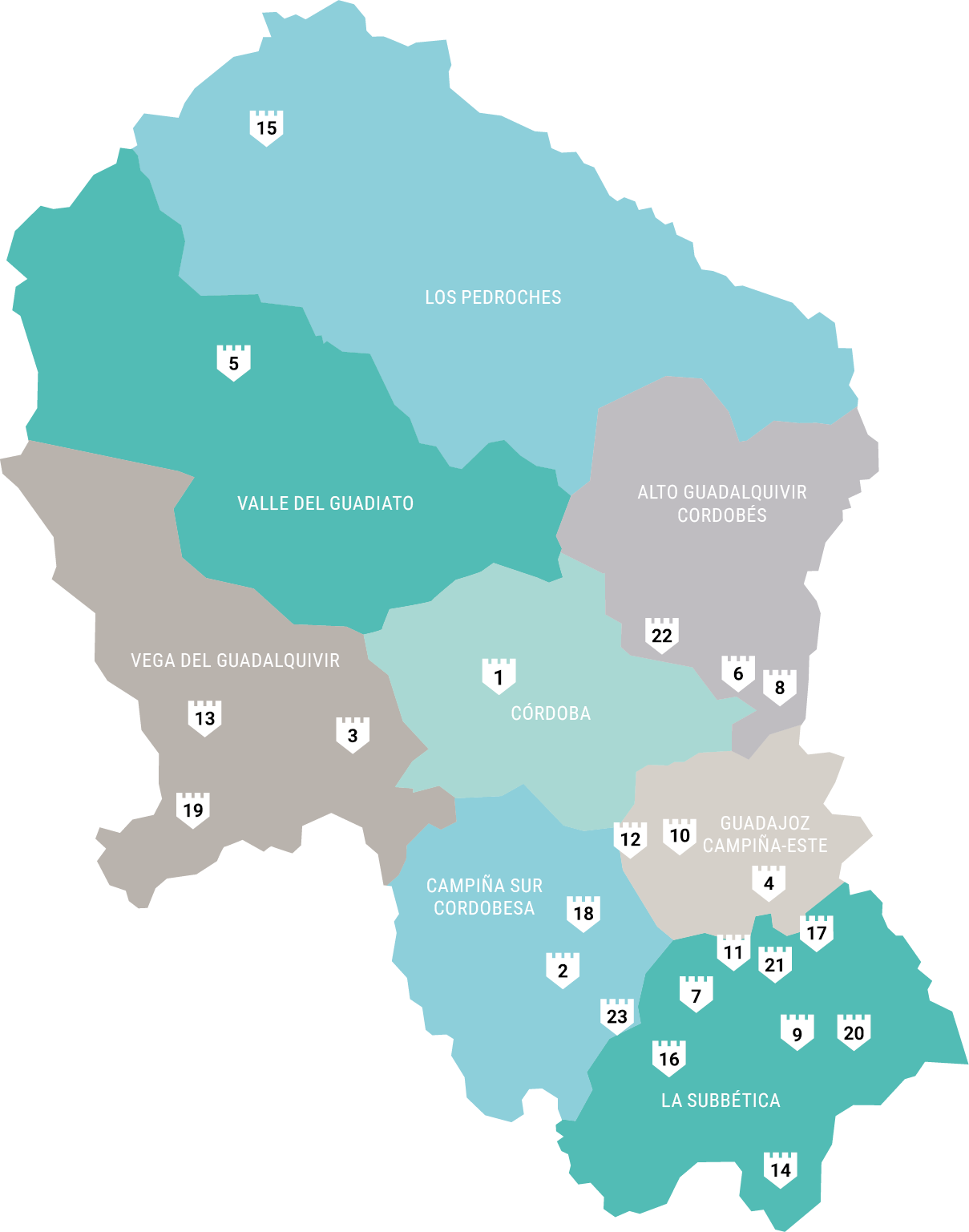
Discover the complete defensive network. Click on the map numbers or use the search bar below.