Iznájar Castle
The Cheerful and Quarrelsome Castle
This castle is an “eagle’s nest” crowning the Subbética. Its Arabic name, Hisn Ashar, holds a duality: it means “Cheerful Castle,” but also “Warlike Castle.”
It was the epicenter of the Muladi rebellion of Umar ibn Hafsun in the 9th century and a key piece in the Nasrid frontier. In 1362, Peter I “The Cruel” conquered it with the help of the Sultan of Granada in a strange alliance. Its walls also inspired the poet Rafael Alberti, who dedicated immortal verses to it after his visit in the 1920s.

Secrets and Legends
From secret passages to verses of the Generation of ’27, the fortress holds fascinating stories.

Rafael Alberti visited Iznájar in the 1920s and was so impressed that he wrote the poem “Torre de Iznájar.” Today, the Keep houses a corner dedicated to the poet.

In the year 886, the rebel leader Umar ibn Hafsun took the castle, turning it into a devastating base of operations against the Emirate of Córdoba, controlling the Genil valley.

Legend tells that there was a secret passage to the Genil river. Some Christian knights captured a servant of the Moorish queen when she went down to bathe, forcing her to reveal the entrance.

The castle’s great cistern maintains a constant temperature of 16-17°C throughout the year, regardless of the outside heat, a marvel of Andalusi engineering.

In 1362, Peter I of Castile conquered Iznájar with the help of Muhammad V of Granada. Four years later, he returned the castle to the Nasrid sultan, a unique case of frontier diplomacy.

In the 18th century, the castle lost its military function to become the residence of the Duke of Sessa’s administrator. Windows were opened in the defensive walls and interior gardens were created.
Architecture of Iznájar Castle

A tour of the defensive and domestic structure of Hisn-Ashar, from its watchtowers to daily life inside.
This imposing prismatic structure is the most visible element of the fortress. Built with masonry and ashlar reinforcements at the corners, it stands strategically on the southwest side. Its function was twofold: to serve as the lord’s residence and act as the last impregnable defensive bastion.
In the center of the courtyard is a huge water tank from the Islamic period (probably 10th-11th century). Rectangular in plan and covered by a brick barrel vault, its sophisticated collection system guaranteed drinking water to the garrison during long sieges.
More than a simple military esplanade, Iznájar’s parade ground is a living archaeological site. Excavations have brought to light the complex urban fabric of the citadel, revealing a superposition of Islamic and Christian structures that coexisted for centuries.
The round path or wall-walk runs along the top of the walls, connecting the different towers. This narrow elevated corridor allowed the guard to watch the horizon and move quickly to defend any point of the perimeter against an enemy attack.
In the lower area is located a vaulted room traditionally identified as stables or guard room. Today, this cool and robust space houses an exhibition of ancient trades, connecting military history with the town’s artisanal tradition.
Archaeological excavations in the eastern sector have unearthed a set of dwellings from the Nasrid period. These domestic structures, with their small rooms and kitchens, offer us a unique window into the daily life of the Muslim inhabitants of the fortress.
Chronological History
Hisn Ashar
Construction of the Islamic fortress. In 886, Umar ibn Hafsun takes it and turns it into a rebel bastion against Córdoba.
Peter I the Cruel
Castilian conquest with Nasrid help. The first church is built. In 1366, the castle is returned to Granada.
Definitive Conquest
Iznájar passes definitively to Castile and is integrated into the domains of the House of Fernández de Córdoba (Duchy of Sessa).
Residential Use
The castle is transformed into an administrative dwelling, losing military elements and gaining domestic comfort.
Prieto Moreno Restoration
Historicist intervention that adds battlements and consolidates the ruin, creating the current image of the castle.
Scientific Recovery
The City Council acquires the castle (1991) and executes a comprehensive archaeological restoration for its tourist opening.
Image Gallery


Plan Your Visit
“Discover the balcony of the Genil in the Subbética”
Hours
Monday to Sunday: 10:00 – 14:00
Afternoons (Fridays and Saturdays): Consult season
Tickets and Contact
General: 2€ | Reduced: 1€
Contact: 641 56 80 20
castillo@iznajar.es
C/ Villa, s/n (La Villa Neighborhood)
Don’t Miss
The Comedy Courtyard (Patio de las Comedias) and the Reservoir Viewpoint
More Castles in Córdoba Province
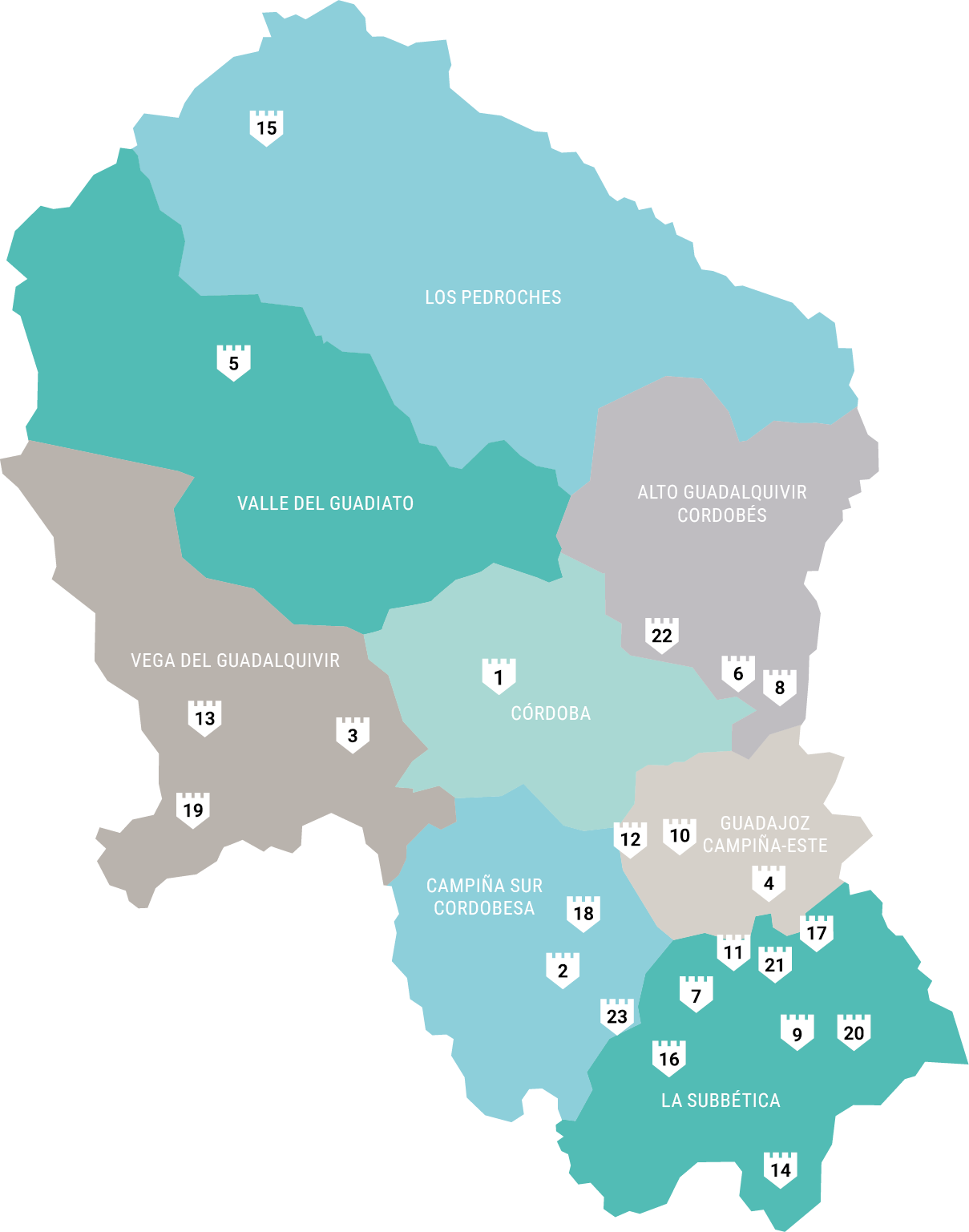
Discover the complete defensive network. Click on the map numbers or use the search bar below.