Castle of Zuheros
Residence of the Fernández de Córdoba
Perched on an impregnable crag, this castle is a geological extension of the Subbética. It was born as Sujaira (“Rock”), a rebel bastion in the Islamic Fitna, and transformed into the ambitious Renaissance residence of the Fernández de Córdoba.
Its history is an interrupted dream: the palace designed by Hernán Ruiz III was never finished, becoming a romantic ruin ahead of its time. Today, after being a movie set and losing its traveling clock, it resurges as the undisputed icon of the town.

Secrets and Curiosities
Between the rock and the wall hide stories of dangerous borders, natural engineering, and legends of love.

In the 16th century, Hernán Ruiz III designed a sumptuous Renaissance palace inside the castle. The work was halted due to a lack of funds, being born as a “romantic ruin” from its origin.

In the 9th century, the castle was fortified by the Banu Himsi, allies of the rebel Umar ibn Hafsun, to challenge the Emirate of Córdoba from this eagle’s nest.

For 250 years (1240-1492), Zuheros was the “hot border” with the Kingdom of Granada. Living here meant being on perpetual alert against Nasrid incursions.

In the 18th century, the keep was converted into a Clock Tower. During the 1960 restoration, the clock was “banished” to the church to return the castle to its medieval appearance.

Legend has it that a Christian captain, imprisoned in its dungeons, wept night and day not for his freedom, but for the impossible love of a Moorish woman from neighboring Baena.

The fortress lacks artificial foundations; its walls are born directly from the living rock of the crag, a natural engineering that made it impossible for enemies to dig tunnels to bring it down.
Architecture of Zuheros Castle

A perfect symbiosis where the bedrock merges with medieval masonry and unfinished Renaissance ashlar.
This prismatic volume is the emblem of the castle. Of Islamic origin (9th century) and rebuilt in the mid-20th century after suffering severe damage, its square plan dominates the landscape. For centuries it lost its military character to serve as a civil bell tower, until the restoration gave it back its military dignity.
Inside the medieval enclosure rise the ashlar walls of a 16th-century palace. The work of Hernán Ruiz III, this project sought to transform the fortress into a Mannerist-style stately residence. Its unfinished windows and moldings are a stone testimony to truncated noble ambition.
The most fascinating thing about Zuheros is its foundation. The wall canvases do not rest on the ground, but emerge organically from the limestone rock of the crag itself. This fusion makes the fortress virtually indestructible from the base, taking advantage of geology as a passive defense.
Essential for life on an isolated crag. This Umayyad-era water reservoir ensured the supply to the garrison. Its robust and waterproof construction allowed the collection and conservation of rainwater, the most valuable resource during prolonged sieges.
A minor tower with a polygonal plan that guarded the steepest access. Built in masonry, it still preserves on its facing the traces of the formwork and the putlog holes of the medieval scaffolding, revealing the construction techniques of its builders.
The wall walk and terraces of the castle today offer a strategic panoramic view of the Campiña and the Vía Verde del Aceite. In the past it served to control the movement of troops; today it gifts the visitor one of the most impressive landscapes of the Cordoban sea of olive trees.
Chronological History
Rebel Sujaira
Construction of the fortress by the Banu Himsi, allies of Umar ibn Hafsun, during the Fitna of the Emirate.
Submission to Córdoba
Musa Ben Yazid surrenders the castle to the troops of Abd al-Rahman III, integrating into the Caliphal defensive system.
Christian Conquest
Ferdinand III the Saint takes the stronghold, which becomes part of the border with the Kingdom of Granada.
The Unfinished Palace
Juan de Córdoba commissions Hernán Ruiz III to build a Renaissance palace that would never be finished.
Clock Tower
The keep loses its military function and is adapted to house the town’s municipal clock.
Restoration
The clock is removed and the battlements are rebuilt, consolidating the ruin and defining the current tourist image.
Image Gallery


Plan Your Visit
“Discover the eagle’s nest of the Subbética”
Opening Hours
Tuesday to Sunday:
10:00 – 14:00 and 17:00 to 19:00 (from April 1st to September 30th)
10:00 – 14:00 and 16:00 to 18:00 (from October 1st to March 31st)
Tickets and Contact
General Admission: €4.00
(Also includes access to the “Juan Fernández Cruz” Museum of Popular Arts and Customs and the Municipal Archaeological Museum)
Tourist Office: 957 69 45 45
turismo@zuheros.es
Plaza de la Paz, 2
Don’t Miss
The Cueva de los Murciélagos (Cave of the Bats) and a walk along the Vía Verde del Aceite (Olive Oil Greenway).
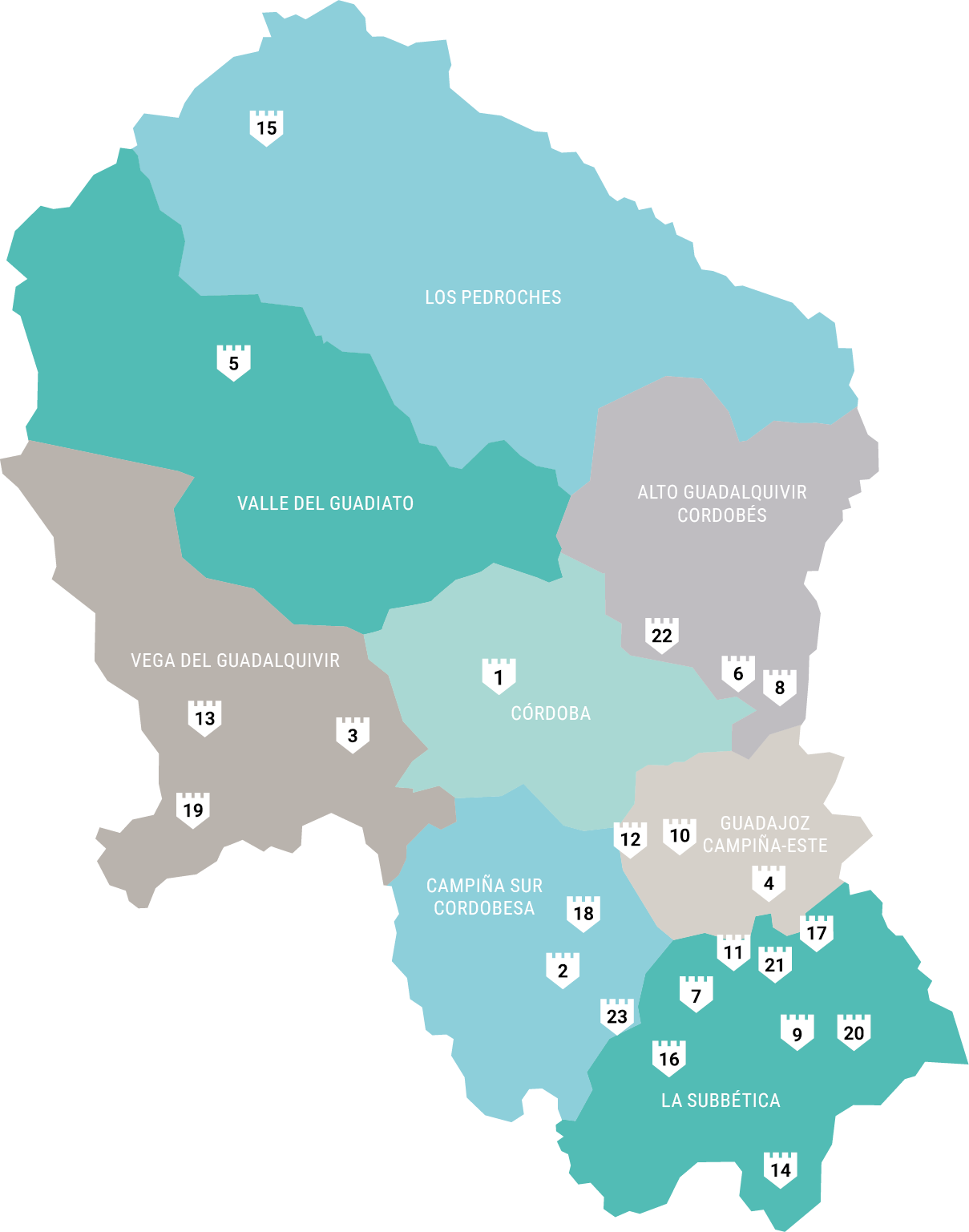
More Castles in Córdoba Province
Discover the complete defensive network. Click on the map numbers or use the search bar below.