Castle-Alcazaba of Bujalance
The Bastion of the Caliphate
This castle is one of the most important historical documents of the region. Erected in the year 935 by order of Caliph Abd al-Rahman III, it served to pacify the Countryside after the Muladi rebellion of Omar Ben Hafsun.
Its original name, Bury al-Hansh (“Tower of the Serpent”), still resonates in the city’s heraldry. It witnessed the transition from the Caliphate to Castile (conquered by Ferdinand III in 1227), the artillery reforms of Queen Joanna I, and its continued use as a Royal Prison and of the Judicial District until the 19th century.

Secrets and Curiosities
Among its ancient rammed earth walls, Umayyad military engineering and later Christian adaptations intertwine.

During the Modern Age, the castle functioned as a Royal Prison for the entire judicial district, taking advantage of the secure vaults and thick walls of the Islamic towers.

Its Arabic name means “Tower of the Serpent.” Legend speaks of a great serpent that inhabited the hill before construction, a symbol of eternal vigilance that passed to the city’s coat of arms.

It was built in 935 AD (10th century) as a state citadel to ensure control of the Countryside and the supply of Córdoba against the rebels of Bobastro.

In 1512, Queen Joanna I of Castile signed the royal decree to finance the restoration and adaptation of the fortress to modern artillery, saving it from ruin.

Oral tradition speaks of “The Seven Towers of Bujalance.” Although time has eroded some, the original plan revealed seven defensive bastions, a number with strong symbolic charge.

Its walls are made of rammed earth (earth compacted with lime), an Andalusi technique that carbonates over time becoming almost indestructible artificial stone, still visible today.
Architecture of the Fortress

With a rectangular plan (59 x 51 meters) and rational design, the citadel is a canonical example of the state architecture of the Caliphate of Córdoba, sober and functional.
Located in the west corner, this tower stands out for the thickness of its walls and its vaulted interior chambers. Its name reveals its historical function: for centuries, its cold rooms served as a prison for detainees of the judicial district, taking advantage of its Caliphate solidity.
Located in the northeast corner, it is a massive structure at its base with a habitable upper chamber. Its function was vital for the communication of the Caliphate state, serving as a link point via carrier pigeons or visual signals with the capital, Córdoba.
The true skin of the castle is its ancient concrete. Built with the “tabiya” technique (earth rich in lime and stones rammed into formworks), this material has carbonated for centuries, creating a monolithic block of ochre color extremely resistant to earthquakes.
It is the tallest and most imposing structure of the complex. Originally an Islamic albarrana tower, it was adapted and heightened by the Christians after the conquest of 1227 to symbolize feudal power over the town and visually control the entire surrounding countryside.
Hidden beneath the floor of the Parade Ground is a hydraulic masterpiece. A large reservoir with brick vaults designed to collect and conserve rainwater, guaranteeing the survival of the garrison in the face of long and dry Andalusian summers.
This vast rectangular space of compacted earth is one of the largest of its kind in Andalusia. Once a stage for military instruction and troop formations, today it has exchanged lances for culture, serving as a grand auditorium for classical theater.
Chronological History
Caliphate Foundation
Abd al-Rahman III orders the construction of Bury al-Hansh over a previous fortification to control revolts and secure the route to Córdoba.
Christian Conquest
Ferdinand III “The Saint” takes the stronghold definitively, integrating it into the Crown of Castile and turning it into a frontier bastion.
Reform of Joanna I
Queen Joanna I grants funds to repair walls and towers, adapting medieval defense to the new times of gunpowder.
Regional Prison
The fortress loses its strict military function and consolidates as the prison of the judicial district and municipal deposit.
National Monument
Official declaration as a Historic-Artistic Monument (now BIC), legally protecting it from demolition and plunder.
Comprehensive Restoration
Completion of major restoration phases and opening to tourist and cultural use, consolidating its structure for the future.
Image Gallery


Plan Your Visit
“Enter the fortress of the Seven Towers”
Tourist Office
Bujalance City Council
📞 957 17 12 89
📧 turismo@bujalance.es
Guided tours by prior reservationHours and Location
Wednesday to Friday: 10:00-13:00 / 17:00-19:00
Weekends: 10:00-14:00
Plaza de Santa Ana, s/n
Don’t Miss
The nearby Parish of the Assumption (“Cathedral of the Countryside”)
More Castles in Córdoba Province
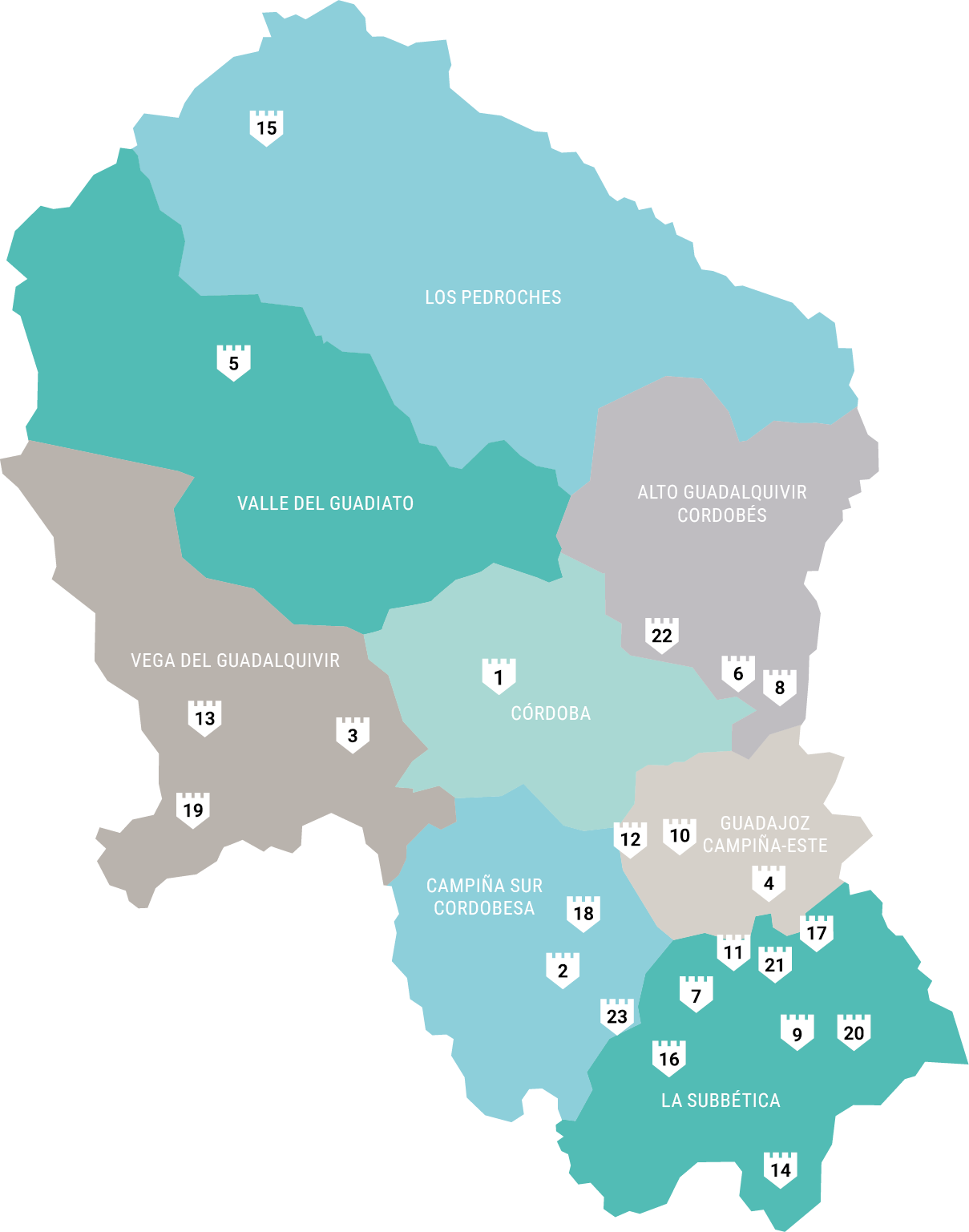
Discover the complete defensive network. Click on the map numbers or use the search bar below.